
Brace! Brace!

In the run-up to the May publication of my new book, Devils in the Details: On Location with Folk Tales in England’s Forgotten County, which can now be preordered, I’m going to post a few snippets - not favourite parts, just a few of the things that seem able to stand up on their own and aren’t very long. Here is an excerpt from the start of a chapter that discusses smugglers and chancers, and goes on to debunk a popular - and still fascinating - local smuggler-murderer legend that seems to have been born a century ago so that an establishment sidelined by a new tourist industry might not die. If you want to know more about that, you’ll have to visit the link above and do the right thing, won’t you?
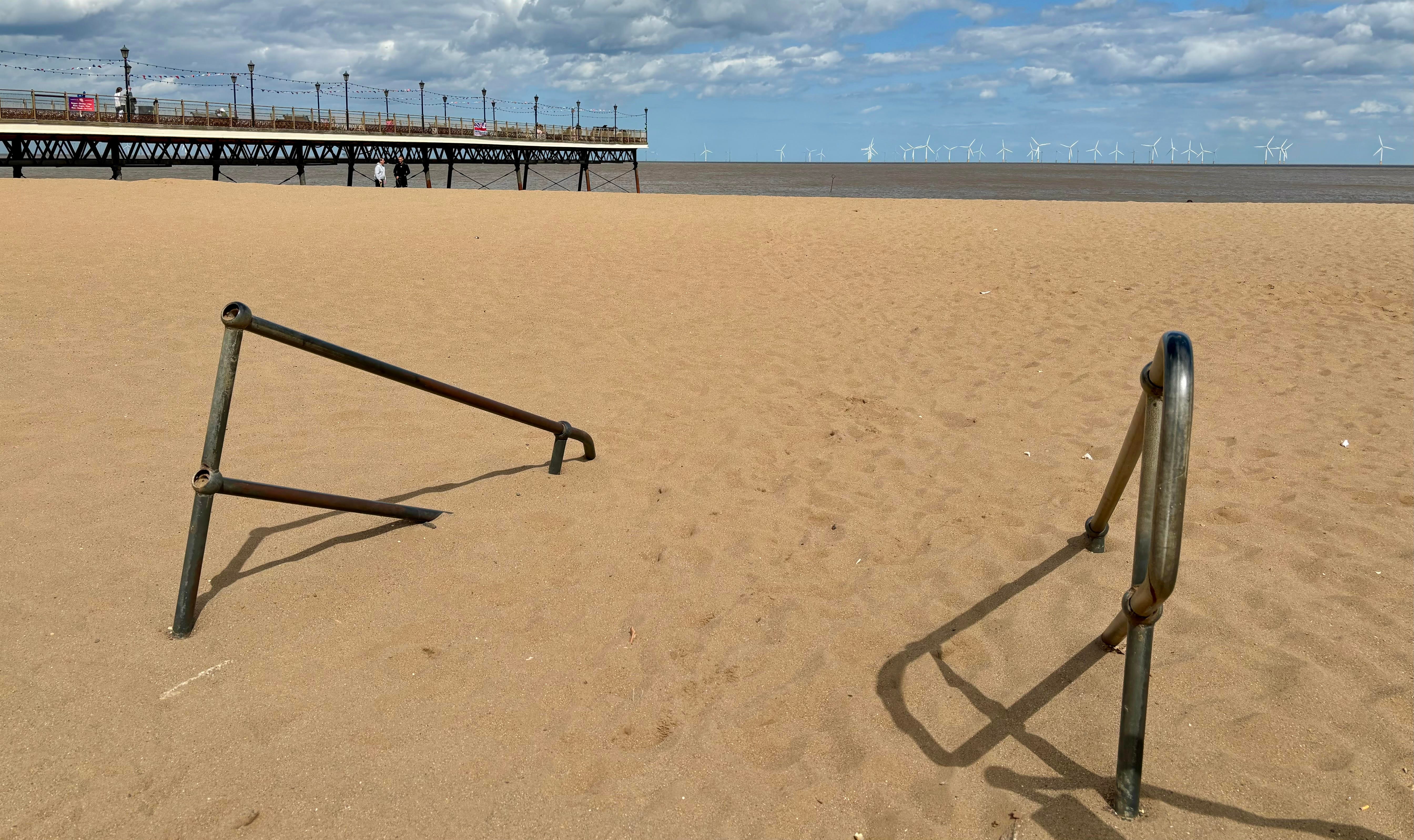
I survey the shore from the prom. Wavelets slide in, turn over, rake out, slide in. It’s a clear summer afternoon, but a bit fresh, and only a handful of windbreaks have already been planted for the day. On the sloppy shoreline, a couple walks as one while a dachshund follows its nose in a squiggly line, tail going like a maniacal counterpart to the wind turbines that have sprouted offshore. I start to count them, tiny at this distance, and give up at one hundred. A seagull laughs overhead then alights on a bin. Two blokes are swooshing metal detectors across the dry sand: human seagulls. A few figures move along the pier. Up close, a little lad throws a handful of sand downwind, to see what will happen, and his mum tells him to pack it in. Somewhere behind us, Shania Twain faintly makes plain that it don’t impress her much, and a mechanical voice laughs and invites nobody in particular to come and have a go, as it has been doing for years – during opening hours, anyway.
Skegness. Skeggy. Skeg. It sounds as glamorous as it is. ‘Let’s go to Skeg’, we’d occasionally say as teenagers in the 1990s, then we’d stand in a stuffed double-carriage sprinter as it limped across the Fens from Sleaford, full already of people from Leicester, Derby, Nottingham, Grantham. I remember an irate dad in Botton’s Amusements imploring his toddler to ‘just eat your fucking cheeseburger’, and a cuddly toy machine brimming with every-angled grinning golliwogs. In 2014, the website Destination Tips listed Skegness as the ninth worst travel destination in the world: ‘a pile of dirt bordering the North Sea with a run-down amusement park idly resting on the land’ that it disfavoured only slightly less vehemently than Pyongyang and Mogadishu.[i] A couple of years later, The Sun provided an impassioned riposte, in which Skegness pier manager Gabriella Wilkinson pointed out that ‘generations of the same family keep coming year after year. They wouldn’t come back if it was as bad as a war zone, would they?’[ii] Fair point. But in 2024, a Which? survey of 3,000 people ranked Skegness again as the worst seaside town in the UK. ‘We’ve heard it all before’, wrote Peter Hennessy, witheringly, in the Nottingham Post. ‘Every year a different poll or survey comes out, and it’s always seemingly pointed towards Skegness, painting the town in a negative light.’[iii] Middle-class people of all political stripes and self-identifications love to take the piss out of what working-class people like to do, of course, and they’re certainly conspicuous by their absence. Perhaps they only know it’s the worst seaside town in the UK because they’ve read that it is.
The name Skegness is Norse, and refers to a headland (ness) and possibly to the personal name Skeggi, meaning a bearded man: ‘Skeggi’s headland’.[iv] There might once have been the remains of a Roman fort here, and certainly in medieval times it was a small port of some importance, sheltered by that southwards-pointing sandy headland. A series of protective barrier islands out to sea, and then the promontory, were slathered away by storms and tides between the twelfth and the early sixteenth centuries, and by 1540, a new village had been rebuilt back from the headless new shore, several hundred yards west of the old town’s increasingly watery grave.[v] The few locals in this much less significant new Skegness fished and (mainly) farmed, grazing sheep on marshy pastures, which were still ‘well adopted’ to the purpose in the 1820s, if also ‘desolate’, the coast beyond them ‘in a state of waste’.[vi] In 1811, 132 people lived here in a scattered settlement, though a few visitors were now also making the journey. By 1851, the population had more than doubled, as people moved in to cater to a gently increasing influx of gentrified tourists in search of healthful sea air – Alfred Tennyson among them.
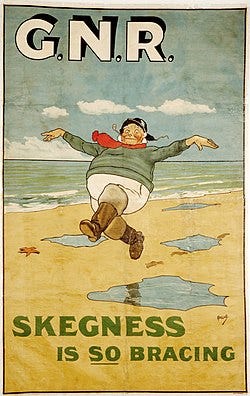
Winds of change were blowing, however. In 1873, a branch railway line to Skegness opened, and a few years later the principal local landowner, the Anglo-Irish Richard Lumley, Earl of Scarborough, decided to revive his fortunes by turning Skegness into a seaside resort of the kind that would encourage the gentrified types to go elsewhere. In 1871 – the year the Bank Holidays Act gave workers several new public holidays, including the first Monday in August – the population of Skegness was 349. A decade later, it had 1,338 residents, the fourth longest pier in England, and the amenities of a town, built on a grid plan centred on two roads named in the Earl’s honour – Lumley Avenue and Scarborough Avenue – with a grand Anglican church, St. Matthew’s, at their crossing.[vii] John Hassall’s rotund, pipe-smoking, apparently flight-attempting Jolly Fisherman first appeared on a Great Northern Railways poster in 1908, above the slogan ‘SKEGNESS IS SO BRACING’; the tourists kept coming from the factory towns of the Midlands, and the conurbation kept growing. Billy Butlin’s first holiday camp opened just north of town in the 1930s, by which time Skegness had a population of over 9,000. Butlin’s was soon commandeered for the war effort, becoming the training ‘ship’ HMS Royal Arthur, and the Nazi propagandist William Joyce, ‘Lord Haw-Haw’, broadcast that it had been sunk.[viii] Then, after the war, the caravan parks that now cover considerably more land than the town started to spring up on its northern outskirts. Even the late-twentieth-century shift towards overseas package holidays did Skeggy’s fortunes as a destination relatively little damage, compared to many other English seaside resorts. However, the town has also long been blighted by deprivation, which still rubs up awkwardly against the cheery chintz on the shore – the combined product of isolation, the perpetual exodus of young adults with prospects and ambitions, and the proportion of employment in low-paid, low-skilled seasonal work.
But there has also been a perpetual influx. Retirees who buy static homes, yes, but also some big characters attracted by the tourists’ propensity to exchange coins for adventures. The most notable is perhaps Harold Davidson, the self-styled ‘prostitutes’ padre’, dubiously implicated in sexual scandal in 1932 while rector (delightfully) of Stiffkey, Norfolk, and defrocked. He took to exhibiting himself in a barrel on Blackpool seafront and denouncing his accusers, like a holier than thou Diogenes. Then, in the summer of 1937, and with interest in his performances having waned in the west, he moved to Skegness, where he played the lead role in a sideshow run by one Captain Fred Rye. Davidson’s gig was to enter a cage containing two lions, armed only with a stick, and to rail against the injustices that had befallen him in much the same way as before. On 28 July, one of the lions disagreed passionately and mauled him to death. Rye immediately grasped victory from the lion’s jaw of defeat: within days, he was tempting would-be punters to come and ‘See the Lion That Mauled and Injured the Rector’.[ix] The year before, one of Rye’s lionesses had escaped his small zoo and made its way across the road to the North Shore Café, the door of which ‘had been closed in the nick of time by Mrs. Vincent the proprietress’.[x] Rye was a chancer, he got away with it, and Skegness provided the opportunity.
The town has also allegedly attracted a less easily identified and captured beast. In 1960, five day-trippers from nearby Wainfleet, perhaps suffering the hallucinatory effects of too many toffee apples, reported seeing what was initially referred to in the press as ‘The Thing’: a torpedo-like marine creature moving ‘about 40 or 50 miles an hour’ up the coast.[xi] Perhaps it was on its way to play with Nessie, interest in which had been revived a few months earlier following the broadcast of film shot by Nessie hunter Tim Dinsdale, showing a little blob of alleged sea serpent swimming away from the shore of Loch Ness.[xii] In any case, there have been infrequent sightings of the Skegness equivalent ever since, and in 2012 a video of a very upright-seeming apparent sea creature, labelled ‘Skegness Monster’, was posted on YouTube and viewed over a million times before it was revealed eight months later to have been a hoax. ‘Why would anyone go to Skegness?’, asked one of the hoaxers. ‘To be honest, we couldn’t think of a reason, so we decided to create one.’[xiii]
Like what you’ve read? Buy the book direct from the publisher / from Amazon / from Waterstones, or from your local independent bookshop.

[i] Katie Rosbottom, ‘11 Worst Travel Destinations in the World You Should Skip’, Destination Tips (5 November 2014) <www.destinationtips.com/advice/11-worst-travel-destinations-in-the-world-you-should-skip/9/> [accessed 24 June 2024].
[ii] Oliver Harvey, ‘Ready, Skeggy, Go!’, The Sun (25 January 2017) <www.thesun.co.uk/uncategorized/2698214/skegness-hits-back-after-seaside-fave-is-named-among-worlds-worst-tourist-destinations-alongside-terrorist-hotspots-war-zones-and-pyongyang-north-korea> [accessed 24 June 2024].
[iii] Peter Hennessy, ‘Skegness Has Been Named as the Worst Seaside Town in the UK – I Challenge Anyone Not to Enjoy Themselves There’, Nottingham Post (26 May 2024) <www.nottinghampost.com/news/local-news/skegness-been-named-worst-seaside-9297676> [accessed 24 June 2024].
[iv] Kenneth Cameron, Dictionary of Lincolnshire Place-Names (English Place-Name Society, 1998), p. 110.
[v] See Caitlin R. Green, ‘The Drowned Villages and Eroding Coastline of Lincolnshire, c.1250-1600’ (10 May 2015) <www.caitlingreen.org/2015/05/drowned-villages-of-lincolnshire.html> [accessed 3 December 2024].
[vi] Skegness U3A Local History Group, Skegness Through the Years (Skegness U3A, 2016), p. 16, quoting Edmund Oldfield, A Topographical and Historical Account of Wainfleet (1829).
[vii] In 1978, a storm destroyed most of the pier, leaving the theatre on the undamaged pierhead looking a bit like an oil rig. In 1995, it burned down. The pier now advances 118 metres from the prom, about a fifth of its original length, its toes occasionally tickling high tide. ‘Skegness Pier – what a great idea!’, declares a sign at its entrance, as though the rhyme bakes truth into the statement. (‘Gonorrhoea – what a great idea!’).
[viii] Winston Kime and Ken Wilkinson, Skegness Past and Present (History Press, 2012), p. 7.
[ix] James Morton, ‘Into the Lion’s Den’, The Law Society Gazette (31 August 2007) <www.lawgazette.co.uk/analysis/into-the-lions-den/2233.article> [accessed 24 June 2024].
[x] ‘Escaped Lioness Thrill at Skegness’, Nottingham Evening Post (29 May 1936), p. 1.
[xi] ‘Mysterious Object Sighted’, Louth Standard (12 August 1960), p. 8.
[xii] Probably a boat. The footage can be viewed at <www.youtube.com/watch?v=GdQUbLKwCvQ> [accessed 20 June 2024].
[xiii] ‘“Skegness Monster” was James May TV Show Hoax’ (26 April 2013) <www.bbc.co.uk/news/uk-england-lincolnshire-22307271> [accessed 21 June 2024]. See also <www.youtube.com/watch?v=AQxbkBgTyl8> [accessed 21 June 2024].