
Notes on a Cambridge Debacle
I’ve written this very hastily, but there are a few things I’d like to get off my chest and the situation seems to be evolving quickly. Pleze ekscus eny leters getin in the rong plaices etc.

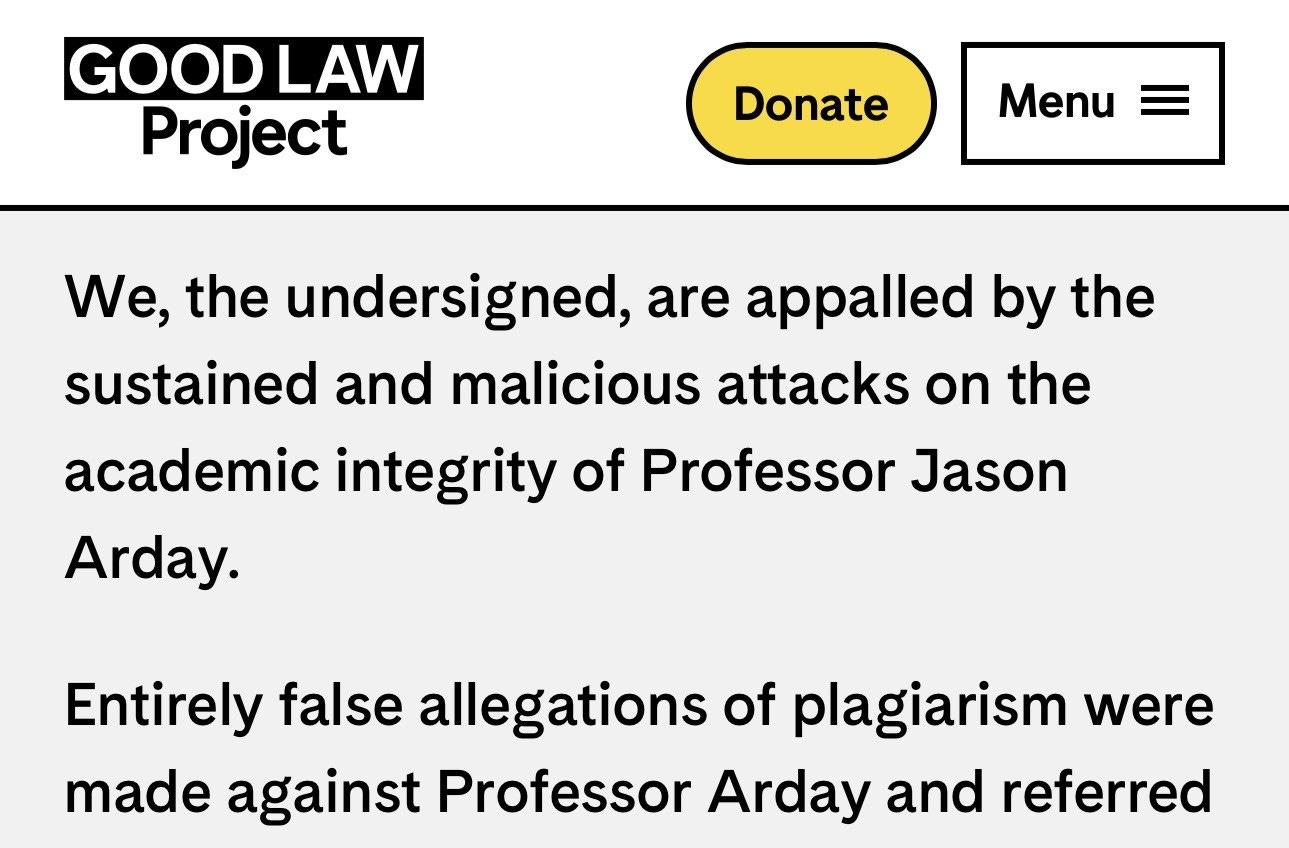
It seems that a Cambridge Professor – one of the most lauded in its recent history – is in especially hot water, following easily-assessed accusations of mass plagiarism and data falsification in his PhD thesis and across much of his slim scholarly output, and scepticism about many of his (in both senses) incredible biographical claims, some connected directly to his job. However, several senior academics (in addition to a fox-bashing lawyer, a couple of actors, and a handful of politicians) have signed an open letter claiming there to be ‘no evidence whatsoever’ of plagiarism in his work, and that all the allegations are ‘baseless’ and ‘entirely false’. A lot has been written about this horrible episode, which will do immense harm of various kinds, and if you are unaware of what has happened this is a good place to start, this is a good place to go next, and this, for now, is the place to finish. I wish instead to focus on the defenders of the indefensible, or at least those of them who really matter.
On 31 July, the professor in question spoke to The Times, and admitted to being a serial plagiarist and falsifier of data (or, rather, ‘did not dispute the allegations of plagiarism’ and accepted other ‘errors’ but does ‘not view them as discrepancies’). This inadvertently threw the signatories – including Professor Sir Simon Baron-Cohen (Borat’s cousin) of the University of Cambridge, Lord Simon Woolley, Principal of Homerton College at the University of Cambridge, Professor Dame Ijeoma Uchegbu, President of Wolfson College at the University of Cambridge, Sonita Alleyne, Master of Jesus College at the University of Cambridge, Professor Ricardo Sabates Aysa at the University of Cambridge, Professor Matt Houlbrook at the University of Birmingham, and Lord Sir Michael Hastings, Chair of SOAS, University of London – under a heavy bus. The Grauniad has (belatedly) published this excellent article about the affair, which should surely be the equivalent of putting the bus into first and slamming down a foot. But that rarely seems to happen to people called Lord Sir Professor Something-Or-Other, does it? They’ll probably all be fine.
I can forgive the open letter signatories outside academia who have assumed the apparent plagiarist is an innocent victim of the right-wing press: the left-wing press has in some cases presented that view, and most people who have come across it will have looked no further than a few gleeful social media posts, many of which have been stabbed into keyboards by bad actors with brains the size of pinheads. Perhaps these signatories should be more curious before responding thus to a story, but they are not, and being curious about the truth of such a matter is not in most cases a professional obligation. Moreover, the story simply has emboldened bigots, so that bit is true enough. The evidence of academic malpractice is nonetheless obvious and extensive, as this post makes abundantly clear, though it only focuses on the prof’s PhD thesis and its cribbing of the thesis of another student six years earlier. The title of the offending document is ‘An exploration of peer-mentoring among student teachers’ [sic] to inform reflective practice within the context of action research’. The use of what should perhaps be referred to as the Cambridge superscript comma even seems to be a carbon copy of the source, where a possessive apostrophe is used correctly.
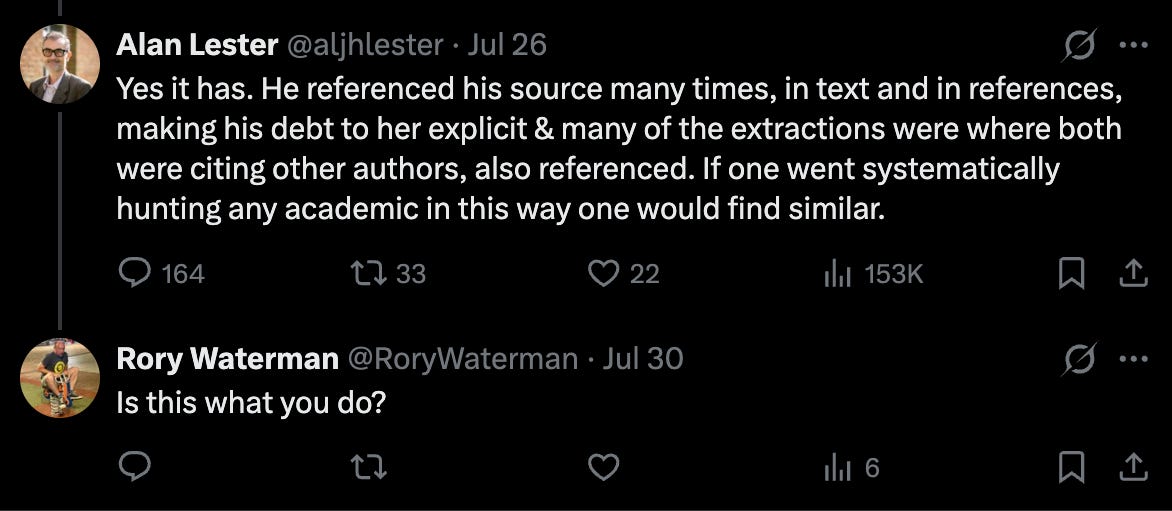
Quite a few academics have also taken to social media to say the accusations of plagiarism are baseless, or that an analysis of any academic’s work would reveal the same pattern of patched-together unattributed thefts – an insulting suggestion that the professor at the heart of the stooshie made himself when he was claiming to be a befuddled victim yesterday in The Times. Either these academics know they are lying, or their own work should come under serious scrutiny; either they are selective ignorers of incontrovertible evidence, or dangerously and jaw-dislocatingly ignorant about the basic standards expected in their profession. In either case, they’re certainly not sticking it to the populist right commentariat and its lackeys, as they seem to have thought they were doing, but instead are arming those people with what will be perceived as evidence, straight from their usually very horsey horses’ mouths. If this sort of theft were indeed normal and justifiable in academia, which it is not, then the social sciences and humanities, at the very least, would be every bit as pointless as the most ignorant, reactionary watchers of GB News like to say they are. These people are making us all look ridiculous and worthless to the general public at a time when the sector is under sustained threat anyway (though probably not at places like Cambridge where most of them do some sort of work). And as Lanre Bakare put it in his article for the Guardian, ‘prominent academics of colour that the Guardian spoke to said the claims of plagiarism were legitimate, and that Arday’s alleged actions risked undermining others who study race.’ Obviously. If what is arguably the most coveted academic position in this field can be given to an apparently exorbitantly fraudulent scholar with a crepe-paper-thin record of serious publications, and he is then protected by lots of Very Important People who might as well be promising that up is down and left is right and that only bigots disagree, serious scholars in aligned fields, with less coveted positions at less prestigious (and protected) universities - and I know several such people - all stand to suffer in perpetuity.
Perhaps some of their - our - more defensive, untruthful, mainly managerial-class, privately-educated academic colleagues have other, bourgeois reasons to want to defend the likes of Cambridge University from well-deserved criticism. Or to defend the sorts of people who (as reported by Retraction Watch) spend many thousands of pounds employing the services of Carter-Ruck – a firm famous for acting as a guard dog for Russian oligarchs and others of that sort – to dissuade journalists from the Times Higher Educational Supplement from doing their jobs. They’re certainly doing no favours whatsoever to scholars from disadvantaged backgrounds. I’ll be happy to look these people in the eye in public, and ask some extremely difficult questions. They’re welcome to get in touch.
Why does this matter so much? Because I think my profession matters a lot, or often does. And because a person with a professorial chair at Cambridge is not above scrutiny – but nor is an elitist system that looks after itself, or seeks to, however inadvisedly. The general public understandably assumes a much-lauded professor at one of the world’s elite universities is at the apex of his profession. League tables of ‘research excellence’ seem to reinforce this, because those institutions get more than their share of external research funding, and are the source of a disproportionate number of highly-regarded research publications. Those tables don’t really reflect inherent merit: simple, age-old prejudice funnels the bulk of funding to supposedly elite universities, to some topics over others, and to some parts of the country over others; scholars at supposedly elite institutions tend to do considerably less teaching and don’t have as many non-research obligations as their counterparts everywhere else. Nonetheless, the general public is bound to believe that a professor at Cambridge is an especially bright star in the firmament. If you try what you have been told is a chef‘s best dish and it tastes exactly like bullshit, you probably don’t want to eat anything else from the same kitchen, and will tell all your friends.
A few additional thoughts, not all strictly relevant.
Do the academics named above sit on student academic irregularity panels? Will they do so in future? I’m fascinated. I’d love to audit one.
Liverpool John Moores University, the prof’s PhD-awarding institution, admitted to giving him one (ONE) supervision during his PhD, according to his interview in The Times. Students of mine get about 12-13 supervisions a year. That is normal in my experience, at least where I work, and I have never had the sense that it wasn’t normal for any of the many PhD students I’ve examined externally. What’s going on?
If Cambridge really wanted to do something to tackle institutional inequality, it could always put a strict and severe cap on home undergraduate admissions from fee-paying schools. At present it is about 30%; 10% would be 1.5 times the national average. This would increase the proportion of British ethnic minority students at Cambridge, apart from anything else, and I can promise it would not decrease standards. It’d probably batter the funding model though…