
(South) Summer Poppleton

In the run-up to the May publication of my new book, Devils in the Details: On Location with Folk Tales in England’s Forgotten County, which can now be preordered, I’m going to post a few snippets - not favourite parts, just a few of the things that seem able to stand up on their own and aren’t very long. Here is an excerpt from the start of the ‘Summer Poppleton’ chapter. I prefer the second half of this chapter, but if you want to know why, you’ll have to visit the link above.
‘Nothing, like something, happens anywhere’, wrote Philip Larkin, at the end of ‘I Remember, I Remember’, a poem about finding himself passing through Coventry, his childhood hometown. Larkin’s speaker ‘leant far out, and squinnied for a sign / That this was still the town that had been “mine” / So long’, but he doesn’t find one.[i] Typically glum Larkin, you might think, and maybe so – but Larkin left for university in 1940, shortly before much of Coventry was turned to rubble and then to concrete, and (like Coventry itself, perhaps) he never really came back, so maybe that is why he didn’t recognise it. No bombs dropped on the leafy little-but-growing village of Dunston, where I went to primary school, excepting occasional social, metaphorical bombs. In the poem ‘Zeps’, written from the home front of the Great War, the dialect poet Bernard Gilbert, from the nearby village of Billinghay, has a wife complaining that her husband shouldn’t ‘mek sich a bloor’ about ‘them Zeps passin’ over; / Them Jarmins!’, and them Jarmins in newer flying machines did nothing more to Dunston than pass over it in the Second World War either.[ii]
Nonetheless, war changed Dunston. My mother, who grew up here, remembers the cockney former land-girl who had married a local dairy farmer and who delivered the milk in big churns. She stood out, apparently happily, but ‘not that much’. A secret giant beech on a country lane nearby – less than six miles from what were the Second World War air bases of RAF Metheringham, RAF Coleby Grange, RAF Waddington, RAF Wellingore, RAF Digby – is wounded and healed with the scars of the date 1943, a blocky aeroplane, an apparent initial, and a vertical line. Perhaps this commemorator lived, and settled round here, and his grandchild who was born because Hitler had invaded Poland is drinking coffee down the road in a corporation-built identikit house on what used to be a meadow. Perhaps the vertical line is the beginning of a tally that might, in a different life, have grown to show a completed thirty-operation tour, and some people in Dresden, Berlin, Dortmund, are drinking coffee this morning because it doesn’t. Perhaps the scar below the port-side wing represents the mythological gremlin that pulled it prematurely to earth. Perhaps a sweetheart carved this in hope, or in memoriam. I’ve gone to look at it a hundred times, and whenever I do it tells me a different improbable story, but one of them might be true. From my perspective, it has always been there, presenting its mystery to a field of wheat.
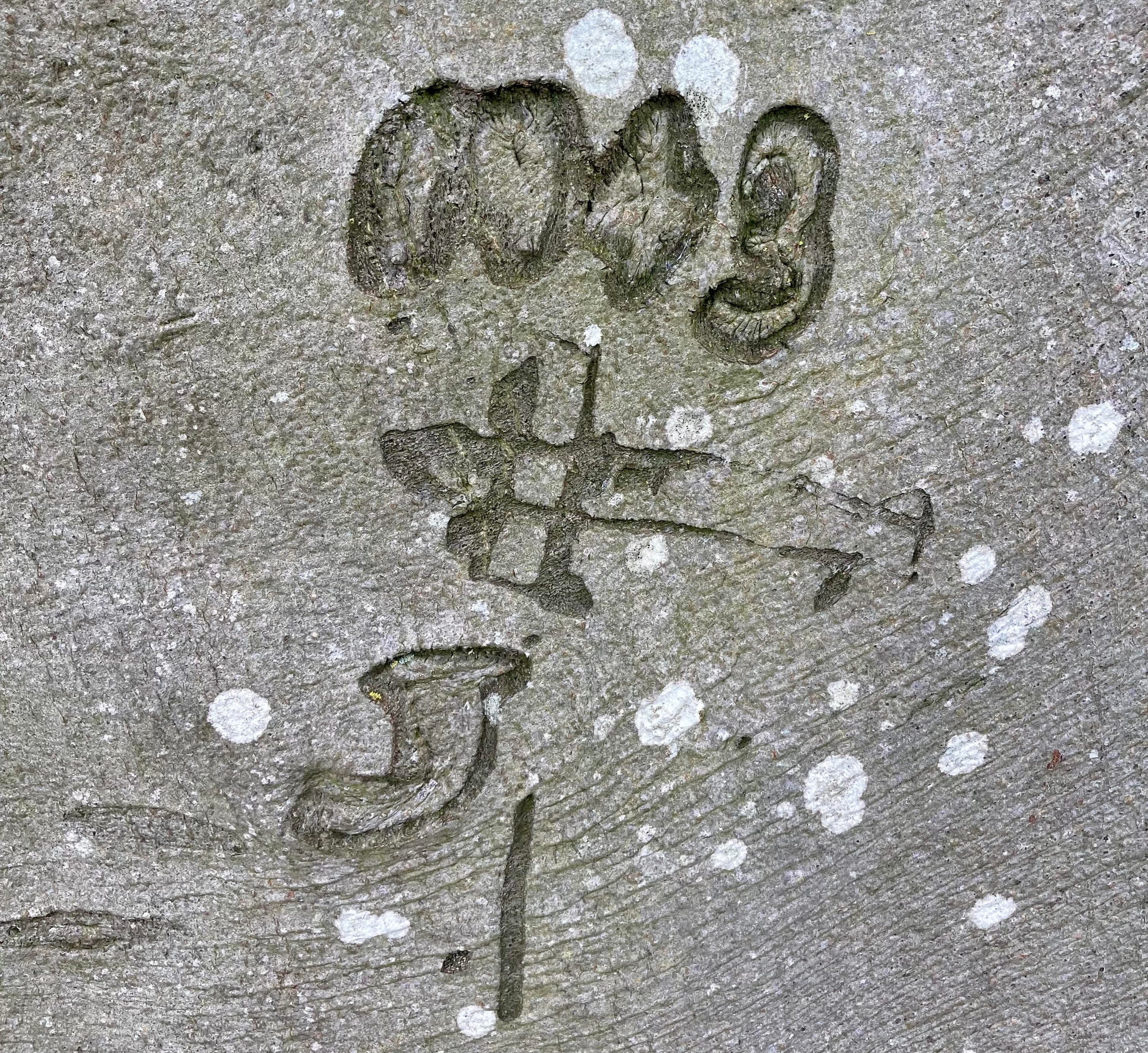
I can testify that nothing of great import seems to happen in Dunston – which was never quite home to me, because I lived a mile away in a lodge house closer to Nocton, the next village, which also wasn’t quite home. But I walked the bridle path between the two every day on my way to and from school, so it was home as much as anywhere else. I’ve been informed by two locals in their seventies, both of whom wish to remain anonymous because (as one put it) ‘times have changed’, that, back in the era of milk-carts that briefly post-dated the Second World War, ‘one or two’ children in Dunston were known to have older sisters who were also their birth mothers. ‘No great fuss was made’, I was told, the passive voice throwing this further into a mistily bygone age that has in fact only recently ended. Even by the sisters, the mothers? ‘The village was very isolated’, apparently, and I believe it.[iii] My mother wasn’t sent to the village school because some of the boys were strongly rumoured to like touching the girls inappropriately, and seemed to be getting away with it. She has frequently pointed out to me where all the different shops used to be, back when the village had a population about half of its current 800 and needed to support them. When I was a child, there were still three shops: a Post Office that had previously been a hairdresser’s salon and is now a house, a den of sweet jars behind curved shopwindows on what is now another house, and a prefab hut full of bread and magazines that has long been cleared away. Dunston hasn’t had a shop for over a quarter of a century, a minor inconvenience that literally isn’t worth remedying.
I walk around the village, a wobbly ring of lanes with a few road-strings coming off it, and take in the former sights. Timmy, who shared his dumper truck with me at playgroup in the Village Hall, lived in that house. David, my first best friend, lived in that boring modern house, on a plot that Mum said was once a pig farm, with his rug-rat brother and military parents. Here, on this corner by the school, I waved him off when his mother came to collect him and take him to a new life in Germany, then I went back to playtime. Here’s the Red Lion, still smelling of the same sweet pub lunch as always, where one hot pre-school summer day I learned that prawn cocktail was my favourite food, apart from the lettuce bit. There’s Alice’s house, up against the church, where her dad tried to teach me guitar every Thursday after school for a manila-enveloped £4 a go, by a window that looked out directly at grave-height. That blocky house by the Village Hall was Andrew’s house, and I knew it had been Mum’s house once. I walk down Front Street, which still feels like it is round the back, past what was Alana’s house. That whitewashed cottage on the bend was Barry’s house and, a few doors down, that was Aimee’s house, and about fifteen years ago I heard they got married. Tuckered out, I sit on a bench on the Green. Behind me: Hayley’s house, where someone I’ve never seen before is mowing the lawn like he’s taking part in a time trial, and Robert’s house, outside of which soapy water dribbles from shining Saxo to mucky drop-kerb. Do any of these people ever come here and look and go away again? Do they still have family here? Do some of them still live here? I wouldn’t recognise most of them. A Tesco delivery van trundles down Fen Lane, then trundles back five minutes later. I wave, but the driver doesn’t wave back. It’s Saturday. I used to kick a ball around this patch of grass most Saturdays. The tree that served as our one irrefutable goalpost has been removed without trace. I haven’t seen any children. An old man appears from nowhere and lets a collie off its lead on the other side, and it runs straight to the beck. I hear a bit of muffled disgruntled quacking. Then man and beast have gone, so I pull a hard heel of bloomer from my pocket, rip it to bits, lope beckwards, and throw it in. How pleasant to watch mallards pull handbrake turns as manna falls from heaven.
Nobody here seems to have heard of it – believe me, I’ve asked – but in 1861, the minor folklorist and poet Edward George Kent wrote what he calls ‘Billy Shuffler and the Lincolnshire Witches’, a tale he swore to be true, and which features this thin thread of near-invisible water that runs west to east for five miles from heath to Witham.[iv] Kent was the archetypal dilettantish folk tale collector of his day: well-educated (i.e. not of the same class as the common people), desirous to impart stories, as he put it, ‘from whence a lesson may be learnt or a moral may be drawn’, and enthusiastic about putting ‘his’ tales into doggerel verse (occasionally blended with long-winded prose), as though to move them into a respectably elevated register.[v] However, Kent’s is the only source that exists for this tale – assuming there was indeed a prior source, and he didn’t just make it up. He certainly claims not to have done so, though that is a common feature of storytelling, and Kent certainly did a lot of reinventing elsewhere, as noted earlier in this book. His contextualising note is endearingly ridiculous: ‘This remarkable occurrence took place’, he writes, when Lincolnshire was ‘the favourite resort of wraiths and witches’, and he tells us that the story was relayed to him by an ‘old veteran’ who had once been told it by his ‘old uncle’:
An aunt of one of his acquaintances once knew a man who had a cousin who knew a boy that was carried away by [witches] and boiled in their infernal cauldrons; and on the very spot, he told me, the spirit of the poor boy was still to be seen wandering about, with a broomstick growing out of his neck and a tin pot in his hand’.[vi]
So, to the story. One night, ‘lo! a fearful shriek’ arouses the butler in a country house, who is too afraid to investigate until he hears ‘alarming sounds from his master’s chamber’ and discovers ‘her ladyship […] fainting in the arms of her husband’ as they stand over an empty cot: ‘the child and heir was gone!’ Billy Shuffler, the gardener, then takes over as the lowly person deserving his lowly status: he surmises that witches have stolen the child, as well as the horses, and promises to ‘sattle ‘em, that I will’, but when the lord and his servants set off on foot to the witches’ den, Shuffler, so ‘brave before’, hears the witches’ howls and decides to fall behind.[vii] The rest of the party makes it to the cave, and his stoical lordship duly saves the day for his swooning, blubbering, helpless wife back home: he finds the baby unattended and scoops it up, and the party heads back on the recaptured horses. They meet Shuffler en route, and give him a nag called Old Simon. Then they notice the witches coming after them, and all but one gallop to safety,
While Billy screamed with all his might,
Which only made his horse’s fright
The worse, for like a fiction’d sprite
He stood.[viii]
‘Silly Billy Shuffler’ (that is a quotation).[ix] Luckily, though, Old Simon eventually starts galloping ‘fast and strong’.[x] One of them has his wits about him, at least.
You might think the tale could end here, but Shuffler would not be seen to have learned his lesson if that were allowed to be the case. Sadly, they’ve only gone and fled in the wrong direction, up to the infernal cave. Old Simon has the wherewithal to bolt upon sight of his erstwhile prison, and the two set off back across the wilderness, witches in hot pursuit. One settles on Old Simon’s back, and Shuffler grows a pair and hits her with his club. They almost make it home: all finally goes well,
Until he came to Dunston Beck,
When he bounded o’er the stream.
But Simon, wearied with the chase,
Fell backwards in the flood.
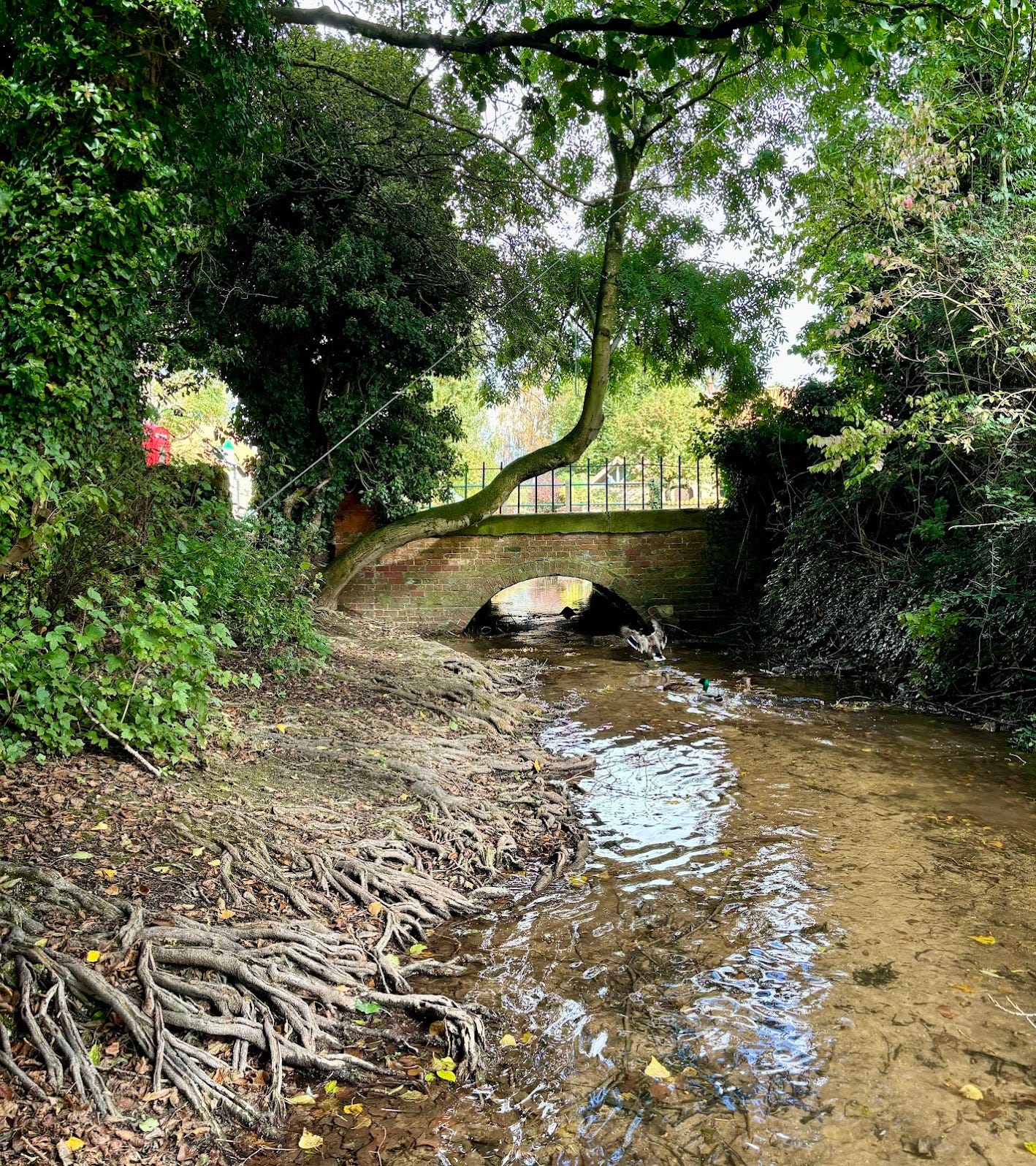
Oh the woe of poor silly Billy. A witch makes off with Old Simon, discarding the hapless Shuffler, who falls ‘into a slumber deep’. He is eventually woken and taken to safety by a villager, who finds him slumped, humiliatingly, with ‘A broomstick wound, deep in his rump’ that ‘let in the clear daylight’.[xi] Patched up, he lopes home, where order has been restored – and then St. Kent of Lindum presents the epigrammatic moral lesson of his parable, in case you might have missed it:
And may old Shuffler’s narrow squeak
A warning be to all
Who are so brave, when there’s no fear,
For they are sure to fall.[xii]
This is wholesome gibberish, apparently taken like bread from the mouths of those who may have told it any number of ways and filtered through a gentrified Victorian disposition. In Kent’s rendition, people demonstrate their respective worth as men and women, and as representatives of the upper and labouring classes. Tradition is ratified. Good overcomes evil, so Divine providence is ratified also. I am reminded of the third verse to Cecil Frances Alexander’s ‘Maker of Heaven and Earth’ (1848), which became the Anglican hymn ‘All Things Bright and Beautiful’:
The rich man in his castle,
The poor man at his gate,
God made them, high or lowly,
And ordered their estate.[xiii]
I imagine Kent singing this heartily from his pew on a Sunday morning.
More down-to-earth (and possibly subversive) counterparts to Kent’s ‘Billy Shuffler and the Lincolnshire Witches’ may once have existed orally, but those can only be guessed at. However, the story has much in common with the legend of Byard’s Leap, set only about twelve miles away: there is again a witches’ den that may be a cave, a baby, a male makeshift paladin who attempts to meet a surprising challenge, and a witch grasping the behind of a fleeing horse – an encumbered, unlikely equine hero that dies nobly, having played a significant role in the rescue.[xiv] And, of course, as in some versions of the much more famous Byard’s Leap story, it takes a person of elevated social standing to save the day. The two stories have too much in common, surely, not to share an origin, and it is possible that the old legend of Byard’s Leap travelled here on a horse and became something else, with local characters. No other comparable narratives have been recorded in Kesteven, this south-westerly quadrant of Lincolnshire, but there is no reason to think they didn’t once exist. We are left to guess, and your guess is as good as mine, or as anyone else’s.
A pair of teenagers that resemble rain-soaked Troll dolls are now blundering across the Green, then they shuffle over the footbridge near what was Ian’s house and enter what was my first teacher Mrs Wilson’s house. Billy Shuffler means nothing here now, and perhaps never meant anything. We have that in common, and it is time for me to go.
I walk past the house that used to be Jenny Tickner’s shop, where I’d get my 20p of penny sweets every day after school (and usually a few more, because she was nice), then along the perimeter of my old school which now has a huge blue roof and the sort of fence you might expect to see around a Russian Embassy, and start down the bridle path to Nocton. Part of this track was once traversed by a branch of a thirty-mile narrow-gauge rail network, the ‘Nocton Potato Railway’, built in the 1920s and finally done away with about thirty years later, following a billion potato-spilling derailments, and upgrades to the lanes around the estate and the spud-hauling vehicles that used them.[xv] A rusted standpipe prodded skywards at a bend in the path when I was a kid – it’s still there, I discover, though now the fragile top has been lopped off and what remains has been painted. It is now complemented by an information board about the railway that probably gets read something like once a month. Soon I’m at the crossroads where one track leads left, up to my old house, and another heads down to the wood. This is where I promised to build Mummy a home for us to move to when I was four. ‘Do you want windows?’ I said, slightly worried. ‘Because I can’t do windows.’ That has entered family lore, the family comprising my mother and me, the childless end of a line stretching back 3.7 billion years to the first microbes. I look left, a little longingly, then proceed to the village, past the meadow pinstriped with ridge and furrow earthworks, in which we stood every Bonfire Night to watch about five rockets and two Catherine wheels whoosh and plop and spin and fizzle as Nocton’s discarded furniture went up in flames. Then I’m spat into the village, near Mike’s old house, where, as perennially frustrated early teens, we listened to Iron Maiden, Skid Row and Metallica and made futile plans to usurp them all. Mike lives a few miles away now, and I’m here to meet him, to traipse with him round Nocton, to rummage through the woods that were our playground, to see what’s left of Nocton Hall, to share reencounters with our ghosts.
Like what you’ve read? Buy the book direct from the publisher / from Amazon / from Waterstones, or from your local independent bookshop.

[i] Philip Larkin, The Less Deceived (Marvell, 1955), p. 38.
[ii] Bernard Gilbert, War Workers and Other Verses (Erskine MacDonald, 1916), p. 44.
[iii] Conversation with author, 1 May, 2024.
[iv] I asked both haphazardly in person throughout 2024 and early 2025, and on the private Facebook group ‘Dunston, Lincolnshire’, which has 1000 members, where my request (1 May 2024) yielded two likes from people I know anyway, and no comments. Edward George Kent, Lindum Lays and Legends (Simpkin, Marshall, and Co, 1861), pp. 221-31. ‘Lindum’ is taken from the Roman name for Lincoln, and points at the author’s misty eyes more than it does at the people from whom he apparently collected, and the things those people might have said.
[v] Kent, p. iii. A very short synopsis of the tale is included in Eliza Gutch and Mabel Peacock, Examples of Printed Folk-lore Concerning Lincolnshire (London: David Nutt, 1908), pp. 87-8. Gutch and Peacock describe it as ‘prolix’.
[vi] Kent, pp. 221-22.
[vii] Kent, pp. 123-4.
[viii] Kent, p. 125.
[ix] Kent, p. 123.
[x] Kent, p. 126.
[xi] Kent, p. 228.
[xii] Kent, p. 231.
[xiii] Cecil Frances Alexander, Hymns for Little Children (1848) (Herman Hooker, 1950), p. 27. This verse is now almost always omitted.
[xiv] The legend concerning the hamlet of Byard’s Leap is discussed in detail earlier in the book.
[xv] Sheila Redshaw and Sue Morris, Nocton: The Last Years of an Estate Village, Volume I (Tucann, 2007), pp. 56-7.